|
PART
NUMBER |
EHS/BS EQUIVALENT(1) |
BREAK STRENGTH |
DIAMETER |
WEIGHT |
CORONA
SOCKET PART
NUMBER |
SVD OR AFS
VIBRATION
DAMPERS |
| IN |
mm |
LBS |
kN |
IN |
mm |
LBS/1000 ft |
kg/km |
 |
| HPTG 1200I |
--- |
|
1,200 |
5.3 |
0.17 |
4.3 |
11 |
16.4 |
CS 1200 |
--- |
 |
| HPTG 2100I |
1/8 EHS |
3.2 |
2,100 |
9.3 |
0.22 |
5.6 |
18 |
26.8 |
CS 2100 |
SVD 0103 |
 |
| HPTG 4000I |
3/16 |
4.8 |
4,000 |
18 |
0.30 |
7.6 |
33 |
49.1 |
CS 4000 |
SVD 0103 |
 |
| HPTG 6700I |
1/4 |
6.4 |
6,700 |
30 |
0.37 |
9.4 |
50 |
74.4 |
CS 6700 |
SVD 0103 |
 |
| HPTG 11200I |
5/16 |
7.9 |
11,200 |
50 |
0.44 |
11.2 |
70 |
104.1 |
CS 11200 |
SVD 0104 |
 |
| HPTG 15400I |
3/8 |
9.5 |
15,400 |
69 |
0.51 |
13 |
95 |
141.3 |
CS 15400 |
SVD 0105 |
 |
| HPTG 20800I |
7/16 |
11.1 |
20,800 |
93 |
0.57 |
14.5 |
115 |
171.1 |
CS 20800 |
SVD 0106 |
 |
| HPTG 27000I |
1/2 |
12.7 |
27,000 |
122.5 |
0.65 |
16.5 |
150 |
223.2 |
CS 27000 |
SVD 0106 |
 |
| HPTG 35000I |
9/16 |
14.3 |
35,000 |
158.8 |
0.69 |
17.5 |
170 |
252.9 |
CS 35000 |
SVD 0106 |
 |
| HPTG 42400I |
5/8 |
15.9 |
42,400 |
192.3 |
0.84 |
21.3 |
230 |
342.2 |
CS 42400 |
AFS 5058104 |
 |
| HPTG 58300I |
3/4" |
19.1 |
58,300 |
264.4 |
0.96 |
24.4 |
300 |
446.3 |
CS 58300 |
AFS 5058105 |
 |
| HPTG 85000I |
7/8 |
22.2 |
85,000 |
385.6 |
1.14 |
29 |
420 |
624.9 |
CS 85000 |
AFS 50589317 |
 |
| HPTG 130000I |
1 BS |
25.4 |
130,000 |
589.7 |
1.56 |
39.6 |
740 |
1,101 |
CS 130000 |
AFS 50589319 |
 |
| HPTG 160000I |
1-1/16 |
27.0 |
160,000 |
725.7 |
1.64 |
41.7 |
910 |
1,354 |
CS 160000 |
AFS 50589319 |
 |
| HPTG 200000I |
1-1/4 |
31.8 |
200,000 |
907.2 |
1.87 |
47.5 |
1,050 |
1,562 |
CS 200000 |
AFS 50589291 |
 |
| HPTG 252000I |
1-3/8 |
34.9 |
252,000 |
1,143.1 |
2.08 |
52.8 |
1,290 |
1,919 |
CS 252000 |
AFS 50589291 |
 |
|
Table 1
(1) Extra High Strength (EHS) / Bridge Strand (BS) steel guys based on Rated Break Strength (RBS)
Kevlar® is a Registered Trademark of DuPont |
| |
WHAT ARE CORONA SOCKETS AND WHEN ARE THEY REQUIRED?
Corona Sockets were developed for the HPTG-I products to protect them from RF burning. The Corona Sockets are aluminum, resin filled, potted end terminations and are always factory installed. PHILLYSTRAN, INC. recommends these potted end terminations for all commercial AM, FM and TV projects, as well as all roof-top installations. The Corona Sockets are the first level of protection for HPTG-I products, with additional levels of protection required for extremely high powered broadcasting stations. (Contact PHILLYSTRAN, INC. for stations operating above 10kw.) See Table 2 for Corona Socket dimensions.
WHAT IS A "GUYING SYSTEM"?
PHILLYSTRAN'S HPTG-I Kevlar fiber guy lines are one component of the HPTG-I Guying System. By offering a system, the user is assured that all details related to the HPTG-I guy line have been addressed. This is the unique factor which differentiates these products from other steel guy alternatives.
The HPTG-I Guying system includes:
- HPTG-I Kevlar guy line in a wide range of sizes
- Proof Tested Factory Installed Corona Sockets
- Vibration Dampers
- Guy Tension Procedure
- Size Selection and Installation Guidelines
- Recommendations for Higher Powered Installations (above 10kw)
|

 |
| CORONA SIZE |
A |
B |
C |
D |
E |
F |
G |
PIN DIA |
WT (LBS) |
 |
| CS1200-4000 |
6.000 |
1.25 |
.406 |
1.875 |
.266 |
1.000 |
4.375 |
.438 |
0.5 |
 |
| CS6700-15400 |
10.000 |
2.375 |
.938 |
2.938 |
.469 |
1.688 |
7.125 |
.750 |
2.5 |
 |
| CS20800-35000 |
14.125 |
3.406 |
1.109 |
4.125 |
.750 |
2.500 |
10.000 |
1.125 |
7.5 |
 |
|

 |
| CORONA SIZE |
A |
B |
C |
D |
E |
F |
G |
PIN DIA |
WT (LBS) |
 |
| CS42400 |
14.875 |
3.750 |
1.406 |
4.750 |
0.797 |
2.125 |
10.875 |
1.125 |
11.1 |
 |
| CS58300 |
17.625 |
4.625 |
1.719 |
4.875 |
1.000 |
2.500 |
13.000 |
1.375 |
18.0 |
 |
| CS70000-85000 |
20.000 |
5.313 |
1.938 |
5.125 |
1.250 |
2.875 |
14.625 |
1.500 |
25.0 |
 |
| CS105000-130000 |
25.000 |
7.500 |
2.750 |
7.875 |
1.531 |
4.375 |
16.688 |
2.500 |
68.0 |
 |
| CS160000-200000 |
27.000 |
7.938 |
2.750 |
9.250 |
2.000 |
4.438 |
18.781 |
2.500 |
85.0 |
 |
| CS232000-252000 |
31.500 |
9.063 |
2.750 |
9.875 |
2.250 |
4.438 |
23.250 |
2.500 |
115.0 |
 |
|
Table 2
Dimensions in Inches |
| |
HOW TO DETERMINE WHAT SIZE HPTG-I IS REQUIRED?
A certified structural engineer should be consulted to determine guy size.
Total Guying where the HPTG-I assembly is greater than 50% of the total guy length: Select the HPTG-I size equal to the EHS steel guy size (recommended by either a structural engineer or tower manufacturer) based on RBS (see Table 1) . Examples: AM, AM Arrays, Communications, Amateur Broadcasting Towers , etc.
Partial Guying where the HPTG-I assembly is 50% or less than the total guy length: Select the HPTG-I size at least one size larger than the EHS size as determined by a structural engineer or tower manufacturer (see Table 4) . Partial guys of HPTG-I should not be less than 10% of the tower height (at the HPTG-I assembly attaching point) in length and should extend equally in all directions at a given guy level. Example is a 3 sided 1,000 foot FM tower with 3 top level HPTG-I assemblies not less than 100 feet in length.
WHAT IS THE PURPOSE OF THE HPTG-I JACKET?
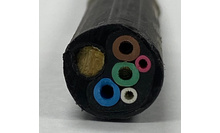
HPTG-I is a non-metallic guy line used in areas where steel guys cannot be used. The Kevlar® fiber core must be protected from the harmful effects of ultraviolet (UV) radiation. This thick extruded jacket is a co-polymer polyurethane with excellent weathering and dielectric properties, blended with carbon black pigmentation for maximum UV resistance. The outer jacket sheds moisture thus assuring consistent dielectric properties regardless of the season or climate.
What is the Life Expectancy of HPTG-I?
HPTG-I differs from other non-metallic guy lines or rods because of the thick protective outer polyurethane extruded jacket (see Table 3) which protects the HPTG-I for many years.
PHILLYSTRAN guy line systems have been in place since the early 1970's, with an expected life of 25 years or more; perhaps the life of the tower(s). Retirement Criteria is based on the condition of the jacket, especially near the base of the corona socket. It is recommended that HPTG-I guy systems be inspected at least annually, more frequently as the guy system ages. |
| |
| HPTG-I POLYURETHANE JACKETING COMPOUND |
|
Table 3
* (1) 25 mil, extruded (2) 75 mil, milled and pressed (3) granules
** Different Scanning Calorimeter, 10 degree C/min. temperature program |
| |
| PHILLYSTRAN® HIGH PERFORMANCE TOWER GUY (HPTG-I) ENGINEERING DESIGN DATA |
 |
| PART NUMBER |
LOAD BEARING AREA
(SQUARE INCHES) |
NOMINAL TENSILE MODULUS
(MILLION PSI) |
10TH CYCLE EA (POUNDS) |
| |
1ST CYCLE |
10TH CYCLE |
|
 |
| HPTG 4000I |
0.0168 |
14 |
15 |
252,000 |
 |
| HPTG 6700I |
0.0280 |
14 |
15 |
421,000 |
 |
| HPTG 11200I |
0.0467 |
14 |
15 |
701,000 |
 |
| HPTG 15400I |
0.0609 |
14 |
15 |
913,000 |
 |
| HPTG 20800I |
0.0862 |
14 |
15 |
1,290,000 |
 |
| HPTG 27000I |
0.112 |
14 |
15 |
1,670,000 |
 |
| HPTG 35000I |
0.142 |
14 |
15 |
2,130,000 |
 |
| HPTG 42400I |
0.188 |
10.5 |
12 |
2,250,000 |
 |
| HPTG 58300I |
0.247 |
10.5 |
12 |
2,960,000 |
 |
| HPTG 85000I |
0.366 |
10.5 |
12 |
4,390,000 |
 |
| HPTG 130000I |
0.675 |
10.5 |
12 |
8,100,000 |
 |
| HPTG 200000I |
1.03 |
10.5 |
12 |
12,400,000 |
 |
| HPTG 252000I |
1.31 |
10.5 |
12 |
15,800,000 |
 |
|
Numbers within the part number designate the rope's break strength.
Weights and Dimensions can vary. |
HPTG-I SIZE SELECTION TABLE WHEN USED AS A PARTIAL GUY (1)
|
 |
| EHS/BS (2) IN. |
RBS LBS. |
HPTG-I/OUTER DIAMETER IN. |
 |
| 1/4 EHS |
6,650 |
HPTG 11200I / 0.44 |
 |
| 5/16 |
11,200 |
HPTG 15400I / 0.51 |
 |
| 3/8 |
15,400 |
HPTG 20800I / 0.57 |
 |
| 7/16 |
20,800 |
HPTG 27000I / 0.65 |
 |
| 1/2 |
26,900 |
HPTG 35000I / 0.69 |
 |
| 9/16 |
35,000 |
HPTG 42400I / 0.84 |
 |
| 5/8 |
42,400 |
HPTG 58300I / 0.96 |
 |
| 3/4 |
58,300 |
HPTG 85000I / 1.14 |
 |
| 7/8 BS |
87,400 |
HPTG 130000I / 1.56 |
 |
| 1 |
115,800 |
HPTG 160000I / 1.72 |
 |
| 1-1/16 |
131,000 |
HPTG 160000I |
 |
| 1-1/8 |
148,200 |
HPTG 200000I / 1.87 |
 |
| 1-3/16 |
163,400 |
HPTG 200000I |
 |
| 1-1/4 |
184,400 |
HPTG 252000I / 2.08 |
 |
| 1-5/16 |
204,000 |
HPTG 252000I |
 |
|
Table 4
(1) Partial guy is 50% or less of total guy length.
(2) EHS or Extra High Strength steel guy strand.
BS or Bridge Strand steel guy strand.
For larger sizes, contact Phillystran, Inc. |
| |
When are Vibration Dampers required?
Guy lines, whether steel or non-metallic, may exhibit aeolian (high frequency) or galloping (low frequency) vibration. HPTG-I is effectively dampened using Preform Line Products' Spiral Vibration Dampers (SVD) or Air Flow Spoilers (AFS, see Table 1). The SVDs are installed in pairs with one pair installed within 6 inches of each end of the HPTG-I assembly. The AFSs are much longer and are installed along the length of the HPTG-I assembly, using four AFSs per assembly. Vibration dampers are recommended for any HPTG-I assemblies greater than 100 feet in length, and greater than 50% of the total guy length. Additional installation instructions are available from Phillystran, Inc.
What is the function of the steel tail?
A steel tail is a length of EHS steel guy line connecting the HPTG-I assembly to the turnbuckle or guy anchor.
The steel tail (required for towers totally guyed with HPTG-I) protects the HPTG-I assemblies from damage due to brush fires, lawn maintenance equipment or vandals. The steel tail length should be sufficient to get the bottom end of the HPTG-I assembly above arm reach, or above brush topes (if located in a marsh or tall brush area). The HPTG-I should never pass through tree limbs or be allowed to rub against poles or tree trunks. The steel tail allows for easier guy length calculations and serves as a guy tension monitoring point, as well as a safer area to attach guy grips during guy line installation and tensioning.
Where can HPTG-I guy systems be purchased and what information is required at time of purchase?
Corporations and government agencies can purchase HPTG-I guy systems directly from the factory located in Montgomeryville, PA. The following information will assist the PHILLYSTRAN representative in determining proper fit and function of the HPTG-I guying system:
- Tower Height and location
- System type, operating power and frequency
- Size of EHS/BS being replaced by or connecting to the HPTG-I assemblies
- Length per assembly
- Is material for shipment outside of the United States
Grounding of Tower and Anchors
Proper grounding of the tower, as well as at each of the anchor points, may be the most important preventative maintenance item for a successful, long lasting HPTG-I Guying System. Grounding will decrease the chances of damage to the HPTG-I caused by RF flashover or lightning. Improper grounding can expose the guy system to damage at both the tower attaching point, as well as at the bottom end connection (where the HPTG-I attaches to the steel tail). Most Electrical and Broadcasting Consultants can advise on proper grounding techniques.
TENSIONING PROCEDURE FOR HPTG-I
The following procedure is suggested for tensioning HPTG-I guy assemblies to tensions as determined by a certified structural engineer or tower manufacturer. It is important that the plumb of the tower be maintained throughout this procedure. Example: Tension HPTG-I assemblies to approximately 15% of its RBS. Guy tension will automatically relax to approximately 10% RBS as indicated by Table 5.
General Stress/Relaxation Phillystran High Performance Tower Guys

Table 5 |
CAUTION: Break Strength: The breaking strength of a rope is the load at which a new rope will break when tested under laboratory conditions. Break strength should not be mistaken for safe working load. Safe Working Load: Because of the wide range of rope use, rope condition and the degree of risk of life or property, it is not possible to make a blanket recommendation for safe working load. It is ultimately dependent on the rope user to determine what percentage of break strength is their own safe working load. Wear: Ropes wear out with use; the more severe the usage, the greater the wear. It is often not possible to detect wear on a rope by visible signs alone. Therefore, it is recommended that the rope user determine a retirement criteria for ropes in their application. For assistance in developing safe working load and retirement criteria for each application please call or write Phillystran, Inc.
All printed statements, data and recommendations are based on reliable information and tests, and are presented without any guarantee or warranty. Statements regarding the use of Phillystran, Inc.'s products and processes are not to be construed as recommendations for use in violation of any applicable laws, regulations or patent rights. © All rights reserved. |
|